
Know Your Customer: 5 Consumer Groups Shaping Butts County Business
Butts County consumer spending patterns can help business owners evaluate where to open, expand, or invest. Before buying a commercial building or signing a lease, it is important to understand who lives nearby, what they value, and how they shop.
Esri’s Tapestry segmentation groups households according to shared lifestyle characteristics, demographics, and consumer behaviors. According to the RPR Trade Area Report for Butts County, five consumer segments account for approximately 80.7% of local households (RPR, p. 2).
For commercial property investors and business owners, these profiles offer useful clues about local demand. Here is what each group may reveal about business opportunities in Butts County, Georgia.
1. Southern Satellites: The Largest Consumer Group
Southern Satellites account for approximately 25.3% of Butts County households, or about 2,280 households. The segment has an estimated median household income of $72,167 and an 82% homeownership rate (RPR, p. 2).
According to Esri’s profile, these households shop at discount and hardware stores, dine at chain restaurants and fast-food establishments, and enjoy outdoor activities such as camping, fishing, hunting, and gardening. Commutes of more than 30 minutes are also common for this group (RPR, p. 3).
What this could mean for businesses: Value-oriented retail, quick-service restaurants, hardware stores, lawn and garden products, and outdoor recreation supplies may be worth evaluating. Businesses that serve homeowners and commuters could also explore locations with convenient access and visibility.
2. Rooted Rural: Practical Purchases and Home Maintenance
Rooted Rural represents approximately 16.7% of households, or 1,507 households, with an estimated median household income of $61,776 (RPR, p. 2).
Esri describes these consumers as favoring generic and domestic brands, shopping at discount and hardware stores, and purchasing items online when they are unavailable locally. Home improvement, landscaping, and auto repair tools are also part of the segment’s shopping profile (RPR, p. 4).
What this could mean for businesses: Hardware retailers, automotive parts suppliers, landscaping services, and stores offering practical household goods may align with these purchasing patterns. Businesses that can provide convenient local access to products residents otherwise order online could also be worth investigating.
3. Scenic Byways: Convenience With a Need for Local Options
Scenic Byways accounts for approximately 16.0% of households, or 1,445 households, with an estimated median household income of $48,428 (RPR, p. 2).
According to Esri, these households shop in person at nearby convenience, discount, and hardware stores, but may travel farther to purchase food and supplies. Maintaining their vehicles, gardens, and homes is also part of the segment’s lifestyle (RPR, p. 5).
What this could mean for businesses: Conveniently located retailers, automotive services, home and garden suppliers, and everyday shopping options may be worth exploring. If residents must travel outside their immediate area for certain products, a local business could potentially meet that need. Additional research would be needed to confirm demand and identify any existing competition.
4. Rural Versatility: Households With Diverse Practical Needs
Rural Versatility represents approximately 12.0% of households, or 1,085 households, with an estimated median household income of $58,911 (RPR, p. 2).
Esri’s profile highlights shopping at hardware and hobby stores, buying groceries from convenience stores and larger retailers, and purchasing automotive tools. Most households in this segment also have at least one pet (RPR, p. 6).
What this could mean for businesses: Automotive services, hardware and hobby retailers, pet care providers, and veterinary services may be relevant concepts to investigate. Businesses that combine convenience with products and services for home, vehicle, and pet needs could also consider whether a local market opportunity exists.
5. Room to Roam: The Highest-Income Group Among These Five
Room to Roam accounts for approximately 10.7% of households, or 967 households. Among the five segments highlighted here, it has the highest estimated median household income at $99,689, a median net worth of $506,754, and an 89% homeownership rate (RPR, p. 2).
Esri notes that these households use coupons, shop at department stores, and purchase equipment for home and yard maintenance, including mowers, trimmers, drills, and saws (RPR, p. 7).
What this could mean for businesses: Lawn and garden equipment, home improvement products, outdoor supplies, and related maintenance services may be worth evaluating. While the income and net-worth figures provide useful context, they do not guarantee that residents will purchase a particular product or service.
What These Five Consumer Groups Have in Common
Looking across the five profiles, several patterns stand out in the RPR report:
- Home improvement and hardware: Tools, maintenance, landscaping, and practical household purchases appear repeatedly.
- Automotive needs: Vehicle maintenance and automotive tools are relevant to multiple segments.
- Value-conscious shopping: Discount retailers, coupons, and generic brands feature in the consumer profiles.
- Outdoor lifestyles: Gardening, yard maintenance, fishing, hunting, and other outdoor activities appear across the segments.
- Convenience and local availability: Some households shop nearby for everyday goods but travel farther or order online for products they cannot easily find locally.
For business owners researching Butts County commercial real estate, these patterns can help generate ideas for potential locations and customer needs.
Auto parts and repair, equipment rental, farm and garden supplies, pet care, outdoor goods, quick-service dining, and value-oriented retail are examples of concepts worth investigating. The data can also help business owners identify products or services that may be underserved locally.
These are research leads, not proven market gaps. Before investing, compare the consumer profiles with local competitors, actual purchasing demand, operating costs, and the characteristics of a specific property.
How to Use Consumer Data When Choosing a Commercial Property
Consumer segmentation is most useful when it informs a broader site-selection process. Here are four ways to put the data to work.
1. Identify Your Likely Customers
Consider which household characteristics and shopping behaviors align with your business. A hardware retailer, pet care provider, and specialty boutique will each need a different customer base.
2. Evaluate the Trade Area
Look at the population and household profile around the specific property, not just the countywide picture. A location in Jackson may serve a different mix of households than one in Flovilla, Jenkinsburg, or an unincorporated part of Butts County.
3. Research Competition and Convenience
Find out which comparable businesses already operate nearby. Determine whether customers have convenient access to similar products and services, and whether there is evidence of unmet demand.
4. Verify the Property’s Suitability
Consumer demand is only one part of the decision. Review traffic and visibility, access, zoning, permitted uses, parking, property costs, and any space requirements your business may have.
Combining demographic data with on-the-ground research helps you assess whether a property fits both your business model and its potential customer base.
Putting the Consumer Data to Work: An Example
Imagine you are considering an equipment rental and small-engine repair shop in Butts County.
Several of the five consumer profiles mention hardware purchases, automotive tools, or maintaining homes and yards. Room to Roam households, for example, are described as purchasing equipment such as mowers, trimmers, drills, and saws (RPR, pp. 4–7).
These patterns suggest a possible connection between local lifestyles and the products or services your business could offer. Your next step would be to investigate demand for equipment rental and repair, assess competing businesses, and identify a site with appropriate space, visibility, access, and zoning.
Now consider a high-end fashion boutique. The profiles emphasize value-oriented shopping and practical purchases more often than luxury fashion. That does not mean the boutique could not succeed, but it would require additional evidence of a suitable customer base.
The goal is not to let a report make the decision for you. It is to use the data to ask better questions before committing to a property.
Find the Right Commercial Property With Better Market Insight
Understanding Butts County consumer spending patterns can help business owners develop more informed site-selection strategies. Esri’s Tapestry profiles provide a starting point for understanding local household characteristics, but they should be combined with property-level research and direct knowledge of the market.
The AMC Realty Team can use RPR and KW Commercial tools to generate trade-area reports for specific addresses in Jackson, Flovilla, Jenkinsburg, and unincorporated Butts County. That can help you evaluate the consumer profile around a property before deciding whether it fits your business plans.
Before You Buy. Before You Sell. Before You Build. Talk to AMC.
Call or text Joy Langford at (404) 313-6910, email jlangford@amc.realestate, or visit www.amc.realestate.
The AMC Realty Team at KW Southern Premier Market Center.
Sources
- RPR Trade Area Report: Butts County, Georgia. Data from Esri, U.S. Census American Community Survey, and the Bureau of Labor Statistics. Report run September 22, 2026, by Joy Langford.
Data note: Esri Tapestry segments describe typical household characteristics and behaviors. They do not represent every household or guarantee consumer demand. Household estimates and demographic figures should be interpreted in the context of the source report. Business owners should independently verify local market conditions, competition, zoning, and property suitability before making investment decisions.
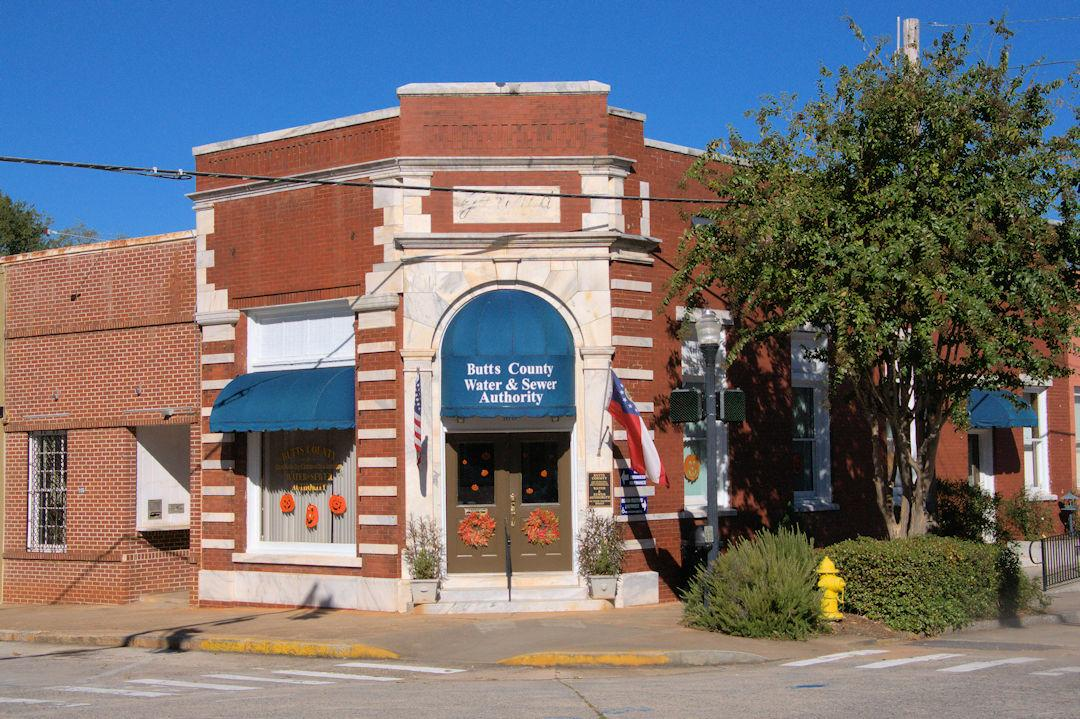
Featured Image Credit: “Butts County CH GA” via Wikimedia Commons, licensed under Creative Commons Attribution 2.0 (CC BY 2.0). View original image.